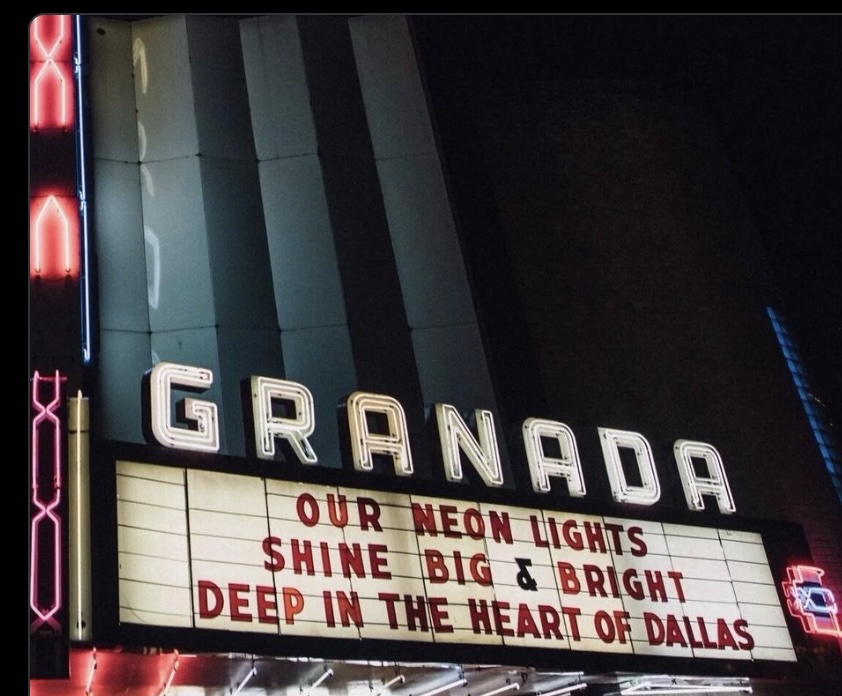
The Greenville Avenue landmark will stop hosting concerts in April 2027, making way for a wellness destination—and leaving Dallas to reflect on the cultural gathering place it is losing.
Dallas is getting ready to say goodbye to a room full of memories. After celebrating its 80th anniversary in 2026, the Granada Theater will host concerts and events through April 17, 2027, before ending its run as a live-music venue. Owners Mike Schoder and Julia Garton have sold the theater and neighboring Sundown at Granada to New York–based wellness company Bathhouse, which plans to bring thermal pools, saunas and steam rooms to the historic Greenville Avenue property.
For generations of concertgoers, the Granada has been more than a place to catch a show. It has been a place for first dates, nights out with friends and unforgettable encounters with favorite artists. Its history includes LGBTQ performers and legendary acts embraced by queer audiences—artists whose songs became part of our lives long after the house lights came up.
A Look Back at the Granada’s Legendary Ladies

The Granada’s own “80 Years of Memories” retrospective highlights an extraordinary lineup of women who have performed beneath its marquee:
- Dolly Parton — November 3, 2002
- Adele — March 15, 2009
- Blondie — October 1, 2011
- Billie Eilish — November 13, 2018
Just imagine that roll call: Dolly’s storytelling, Adele’s powerhouse voice, Blondie’s downtown cool and a young Billie Eilish on her way to becoming a global phenomenon.
These performances capture what made the Granada special: the chance to experience major talent in a room intimate enough for the night to feel personal.
Queer Artists Were Part of the Story
Billie Eilish’s November 2018 appearance came years before she publicly discussed her attraction to women. Looking back, her Granada show offers a snapshot of an artist early in a career that would grow far beyond smaller concert halls.
Big Freedia, New Orleans’ Queen of Bounce, also performed at the Granada on October 7, 2021. An openly gay artist celebrated for an unapologetic approach to music and self-expression, Freedia brought another unmistakably queer voice to the theater’s history.

Alongside those LGBTQ performers were artists such as Dolly Parton, Adele and Blondie, whose music holds a special place in many queer fans’ lives. Their connections to LGBTQ audiences are different, but together they represent the range of voices and experiences that made the Granada’s concert calendar memorable.

What Exactly Is Bathhouse?
The name may prompt a double take, but the announced business is a commercial wellness destination—not a gay bathhouse.
Bathhouse describes its concept as a social alternative to the traditional spa, combining bathing, bodywork and spaces where people can relax together. Plans for Dallas include thermal pools, saunas and steam rooms.
There is an important distinction in the timeline: April 2027 marks the end of concerts, not the opening of the new business. Bathhouse is expected to open in 2028, with an exact opening date still unconfirmed.
The redevelopment is intended to retain the Granada’s facade, marquee and much of its exterior. Inside, however, the experience will change dramatically. Reported plans include demolishing Sundown at Granada and expanding the theater building.
The familiar marquee will remain, but what waits beneath it will be something entirely different.
Saving the Building, Losing the Stage
The sale offers a complicated kind of preservation. The Granada will remain recognizable from Greenville Avenue, but the live performances that gave the building so much of its identity will disappear.
Schoder and Garton have said they previously rejected developers interested in demolishing the property. They also described the pressures behind their decision to sell, including rising labor, insurance and operating costs, the experience of the pandemic, and the demands of running the businesses.
That context matters. Keeping a beloved venue alive takes more than public affection. It takes money, labor and people willing to shoulder the uncertainty year after year.
Still, it is possible to understand the decision and mourn the outcome.
A historic building can survive while the experience that made it meaningful slips away. Saving the marquee preserves a piece of Dallas architecture. Losing the stage means losing the possibility of another generation discovering its favorite artist inside.
What This Means for Dallas
For LGBTQ Dallas, the Granada’s closing is a reminder that meaningful gathering places are not limited to bars, clubs or spaces explicitly labeled queer.
Sometimes they are concert halls where friends gather to sing every word. Sometimes they are rooms where an LGBTQ artist takes the stage and makes someone in the audience feel seen. Sometimes they are simply places where a night out becomes a memory shared for decades.
Bathhouse may develop its own community and give the property a new purpose. But wellness and live music offer different kinds of connection. A sauna cannot replace the collective rush of a favorite song, just as a preserved exterior cannot fully preserve what happened inside.
Dallas is not losing the building altogether. It is losing a particular way of coming together.
There Is Still Time for One More Show

The farewell is not immediate. Granada concerts and events will continue through April 17, 2027. Sundown at Granada will end regular restaurant service on November 1, 2026, with private events continuing through December 31.
The Granada opened as a movie theater in January 1946. Across eight decades, it evolved into a place where Dallas watched stories unfold on screen and later made memories in front of a stage.
Before the steam rooms arrive, there is still time to stand beneath the marquee, step inside and make one more.
Keep the Concerts, Rethink the Heat
There’s another intriguing wrinkle to Bathhouse’s business model: at its New York locations, the company has used heat generated by Bitcoin-mining computers to warm its pools—giving “mining pool” a whole new meaning. We would still rather see the Granada remain a theater, with the energy coming from the stage instead of a bank of computers. But elsewhere, the concept raises an interesting possibility for a gay bathhouse such as Club Dallas: could a small AI computing operation generate revenue while its waste heat helps warm pools or hot tubs? Data-center heat is already being recovered to warm swimming pools, so the underlying idea is more than science fiction, although making it financially worthwhile would depend on equipment costs, electricity prices and the engineering needed to deliver water at the right temperature. To be clear, this is a possibility, not an announced Club Dallas project—but putting servers to work behind the scenes could offer a creative way to support a spa without sacrificing another concert stage.
Leave a Reply