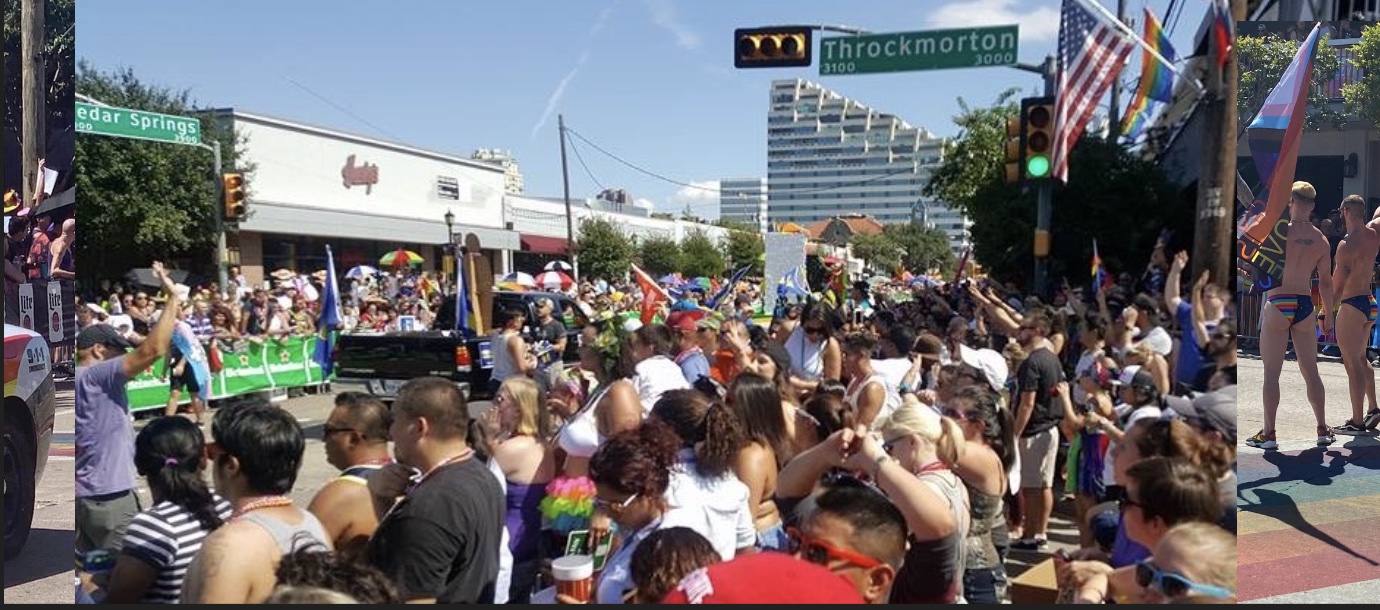

New population estimates reveal nearly 633,000 LGBTQ+ adults in the Dallas–Fort Worth area, highlighting the community’s growing importance to Texas tourism, businesses, and historic gay neighborhoods.
Texas is home to more than 2.2 million LGBTQ+ adults, giving the Lone Star State the second-largest LGBTQ+ population in the country, behind only California. The findings challenge some long-standing perceptions about Texas and demonstrate the considerable size of a community whose economic and cultural influence reaches well beyond the state’s traditional gay neighborhoods.

According to an August 2026 report from the Human Rights Campaign Foundation (HRC), approximately 12.5% of Texas adults identify as lesbian, gay, bisexual, transgender, queer, or another LGBTQ+ identity. Nationally, the organization estimates that 25.6 million adults identify as LGBTQ+, representing roughly 12% of the adult population.
The Dallas–Fort Worth metropolitan area accounts for an estimated 632,947 LGBTQ+ adults, while greater Houston is home to approximately 565,912. Together, the two metropolitan areas represent more than 1.1 million LGBTQ+ adults, a population large enough to influence everything from tourism and entertainment to housing, retail, and business development.
For North Texas, the findings reinforce an important point: Dallas’ LGBTQ+ community is much larger than the nightlife district surrounding Cedar Springs Road. It extends across Fort Worth, Arlington, Plano, Irving, Frisco, Denton, and dozens of rapidly growing suburban communities.
Dallas–Fort Worth Emerges as a Major LGBTQ+ Population Center

With approximately 633,000 LGBTQ+ adults, Dallas–Fort Worth has one of the country’s largest metropolitan LGBTQ+ populations. That represents roughly 13% of the region’s adults, according to the HRC estimates.
The size of the community is particularly noteworthy given the region’s continuing suburban expansion. While OakLawn remains the historic center of LGBTQ+ life in North Texas, residents increasingly live, work, and socialize throughout the metropolitan area.
For decades, Dallas’ gay community was closely associated with OakLawn and the Cedar Springs entertainment district. Those neighborhoods provided welcoming gathering places, businesses, and social networks during periods when openly LGBTQ+ people faced greater challenges elsewhere.
Today, LGBTQ+ residents are part of nearly every North Texas community, from established Dallas neighborhoods to growing suburban cities such as McKinney, Allen, Richardson, and Mansfield.
This broader geographic distribution presents opportunities for businesses seeking to reach LGBTQ+ customers. Restaurants, entertainment venues, retailers, and professional services no longer need to rely exclusively on visitors living near Oak Lawn. Their potential audience stretches across the entire region.
However, the metropolitan population figure should not be confused with the number of LGBTQ+ residents living within Dallas city limits. The estimate covers the full Dallas–Fort Worth–Arlington metropolitan area, and separate city-level population figures cannot be reliably calculated from the regional total.
Houston and Austin Offer Diverse Models of LGBTQ+ Community Growth

Houston, Texas’ largest city, has long maintained a prominent LGBTQ+ community centered around Montrose. The neighborhood developed into a nationally recognized gay district during the 1970s and 1980s, attracting nightlife establishments, independent businesses, restaurants, and cultural organizations.
Today, the greater Houston area has nearly 566,000 LGBTQ+ adults, according to the HRC estimates. Like Dallas, its LGBTQ+ population extends well beyond the neighborhood traditionally identified with gay nightlife.
Montrose has experienced extensive redevelopment, bringing new residential construction and businesses while raising questions about the preservation of its historic LGBTQ+ character.
Austin presents a somewhat different picture. Although the city has a highly visible LGBTQ+ community, its social scene is less concentrated in one residential neighborhood. Downtown’s Fourth Street entertainment area serves as a recognizable nightlife destination, while LGBTQ+-friendly establishments and cultural events operate throughout the city.

Austin’s music industry, universities, technology sector, and arts community contribute to its identity as a destination for LGBTQ+ residents and travelers. In August 2026, the city recognized the historic significance of its Fourth Street LGBTQ+ district with a historical marker.
A directly comparable 2026 LGBTQ+ population estimate for the Austin metropolitan area has not been confirmed for this article. Earlier estimates use different research methods and should not be treated as equivalent to the new HRC figures for Dallas–Fort Worth and Houston.
What these three metropolitan areas share is an increasingly dispersed LGBTQ+ population supported by recognizable cultural districts that remain important to their cities’ identities.
Why Texas’ LGBTQ+ Population Matters to Advertisers and Businesses

The number of LGBTQ+ adults living in Texas represents a considerable potential consumer market, particularly for businesses operating in the state’s largest metropolitan areas.
Historically, advertising directed toward LGBTQ+ audiences was concentrated around nightlife, Pride celebrations, entertainment publications, and neighborhood businesses. While those markets remain important, the community’s geographic reach and demographic diversity suggest opportunities across a much broader range of industries.
Hotels, airlines, restaurants, real estate agencies, healthcare providers, retailers, financial institutions, and entertainment companies all serve LGBTQ+ consumers.
For businesses in North Texas, the regional population estimates offer a reason to reconsider how they approach advertising. A company marketing exclusively within Dallas’ Oak Lawn neighborhood could overlook LGBTQ+ customers throughout Fort Worth and the surrounding suburbs.
Regional LGBTQ+ publications and digital platforms also have an opportunity to serve audiences beyond the traditional entertainment districts. News coverage, travel information, events, business directories, and community resources can connect readers across a metropolitan area that spans numerous cities and counties.
The size of the population does not, however, establish its total spending power. The HRC research estimates how many adults identify as LGBTQ+; it does not measure their collective income, consumer expenditures, or annual tourism spending.
U.S. Census Bureau research provides some additional economic context. In 2024, the agency estimated approximately 1.4 million same-sex couple households nationwide, nearly twice the number recorded in 2005. Married male same-sex couples had a median household income of approximately $140,500, compared with $108,500 for married female same-sex couples.
Those statistics represent particular household categories rather than the broader LGBTQ+ population. They illustrate the importance of studying different demographic groups without assuming all LGBTQ+ consumers share the same income levels or purchasing habits.
For advertisers, reaching this audience effectively requires more than placing a rainbow flag in a promotional campaign. Businesses that understand local interests, support community organizations, and maintain welcoming customer experiences may be better positioned to develop lasting relationships.
Dallas Tourism Has an Opportunity to Expand Its LGBTQ+ Reach
Tourism already contributes substantially to the Dallas economy. According to Visit Dallas, the city welcomed more than 27.7 million visitors in 2024, generating approximately $10.9 billion in economic impact and supporting more than 60,000 jobs.
Those figures cover overall tourism rather than LGBTQ+-specific spending. Nevertheless, the size of the regional LGBTQ+ population provides a useful starting point for evaluating how Dallas markets itself to residents and visitors.
Oak Lawn and Cedar Springs remain among the city’s most recognizable LGBTQ+ destinations. Nightclubs, restaurants, bars, entertainment establishments, and community organizations have helped give the district an identity extending far beyond North Texas.
Dallas also offers attractions that appeal to travelers regardless of sexual orientation, including major sporting events, museums, performing arts, shopping, and a substantial convention industry.
Combining those attractions with more visible LGBTQ+ destination marketing could help position Dallas for weekend travelers, conventions, weddings, reunions, and cultural events.
Houston has already developed dedicated LGBTQ+ tourism marketing through its official visitor promotion efforts, while Austin incorporates LGBTQ+ nightlife and cultural events into its broader tourism identity.
Dallas has its own LGBTQ+ visitor information and established reputation, but the new demographic estimates suggest there may be room to expand regional outreach.
That could include promoting Oak Lawn alongside downtown attractions, connecting visitors with LGBTQ+-owned businesses, and encouraging hotel partnerships during major community events.
An especially important opportunity involves travelers from smaller Texas cities and neighboring states who may see Dallas as a convenient destination for entertainment and LGBTQ+ cultural experiences.
Can Texas’ Historic Gayborhoods Remain Economically Strong?
The future of traditional gay neighborhoods may be one of the most interesting questions raised by Texas’ expanding and increasingly dispersed LGBTQ+ population.
Dallas’ Oak Lawn, Houston’s Montrose, and Austin’s Fourth Street district developed their identities during periods when LGBTQ+ residents had fewer openly welcoming social spaces. Over time, these neighborhoods became centers of community organization, nightlife, cultural expression, and independent business.
Their success helped establish LGBTQ+ visibility in some of Texas’ largest cities. Yet the neighborhoods now face a changing business environment.
Rising property values, redevelopment, commercial rents, and evolving entertainment habits can create challenges for longstanding establishments. Younger residents may socialize in different ways, while suburban LGBTQ+ communities increasingly have more local dining and entertainment choices.
A metropolitan area’s population growth does not necessarily translate into increased foot traffic for historic gay districts.
For Oak Lawn, maintaining long-term stability may depend on attracting customers throughout the week rather than relying predominantly on weekend nightlife.
Restaurants, retail establishments, coffee shops, community events, cultural attractions, and neighborhood festivals can broaden the district’s appeal. Business partnerships with nearby hotels and tourism organizations could also introduce new visitors to Cedar Springs Road.
Preserving the neighborhood’s LGBTQ+ identity is another consideration. Redevelopment can bring investment and additional residents, but it can also affect the affordability and continuity of businesses that helped establish the district’s reputation.
Cities face the challenge of encouraging economic development while recognizing the cultural significance of historic LGBTQ+ spaces.
The expanding regional population provides a potential customer base for these districts, but their success will ultimately depend on how effectively businesses, property owners, community organizations, and city leaders respond to changing conditions.
What Government Data Tells Us About LGBTQ+ Population Growth
The new HRC findings draw on responses collected through the U.S. Census Bureau’s Household Pulse Survey between 2021 and 2024. Researchers analyzed more than 2.4 million responses to estimate the LGBTQ+ adult population nationally and across individual states and metropolitan areas.
That approach differs from the traditional decennial Census, which does not directly enumerate every LGBTQ+ person.
Other major surveys have produced somewhat different national estimates. Gallup, for example, has reported a smaller percentage of adults identifying as LGBTQ+ than the HRC analysis.
Differences can result from survey methodology, how questions are presented, sampling procedures, and respondents’ willingness to disclose their identities.
The figures therefore represent statistical estimates rather than an exact count of every LGBTQ+ adult living in Texas.
They also should not be interpreted as proof that millions of residents recently moved to the state or that the LGBTQ+ population suddenly increased by a particular amount. More inclusive survey questions and changing patterns of self-identification can contribute to differences between studies.
Even with those limitations, the research provides a valuable perspective on a population that historically has been difficult to measure consistently.
The Bigger Picture for Dallas–Fort Worth
Texas’ LGBTQ+ community is neither small nor confined to a handful of urban neighborhoods. With more than 2.2 million adults statewide, it represents a substantial part of the state’s social and economic landscape.
For Dallas–Fort Worth, the estimate of nearly 633,000 LGBTQ+ adults underscores the community’s reach across North Texas and its relevance to regional business and tourism planning.
Advertisers have an opportunity to build relationships with a broad and geographically dispersed audience. Tourism organizations can develop more coordinated campaigns that connect LGBTQ+ travelers with local hotels, entertainment, cultural attractions, and community events.
Meanwhile, established neighborhoods such as Oak Lawn face the task of remaining attractive and economically viable without losing the character that made them important gathering places in the first place.
The growth and visibility of LGBTQ+ communities throughout Texas need not diminish the importance of traditional gayborhoods. Instead, those neighborhoods have an opportunity to evolve into cultural destinations serving a much larger metropolitan population.
For Dallas, Cedar Springs Road remains more than a collection of bars and businesses. It represents decades of community history and a distinct part of the city’s identity.
The new population figures reinforce the importance of that legacy while pointing toward a future in which LGBTQ+ life in North Texas extends across the entire region.
Leave a Reply